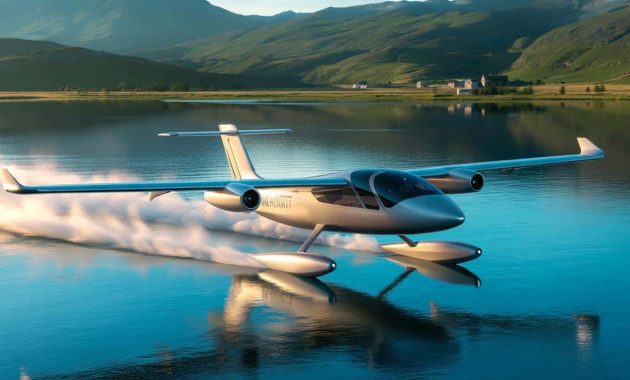
In the Rhône valley, a team of engineers is working on a 19-seat electric aircraft that looks nothing like the planes we know. Their goal sounds almost unreasonable at first glance: carry passengers over 500 kilometres, take off from a runway or a lake, and use around eleven times less energy than today’s regional aircraft.
A radical rethink of regional aviation
The project is called Gen-ee, and it comes from Eenuee, a young aerospace company based near Saint-Étienne in eastern France. Founded in 2019, the startup targets a very specific niche: short regional routes that are currently unprofitable for airlines, yet vital for isolated territories.
Gen-ee is designed for 19 passengers, with a fully electric propulsion system and a range of about 500 km. That puts it in direct competition with small turboprop commuters that connect secondary cities today.
Gen-ee’s designers claim an aircraft that can use around eleven times less energy than a conventional regional plane on similar routes.
The aircraft is being developed under European CS-23 certification rules, which govern light commuter planes. Eenuee is targeting a first flight in 2029, supported by a strategic partnership with Duqueine Group, a French specialist in advanced composite materials.
Why “impossible” suddenly looks plausible
On paper, a fully electric 19-seater with 500 km range sounds like science fiction. Battery technology still trails far behind kerosene in energy density. So Eenuee’s approach is to squeeze every last watt of efficiency out of the aircraft.
The claimed 11-fold energy gain rests on three pillars: aerodynamics, propulsion efficiency and low mass.
A blended wing body instead of a flying tube
Traditional airliners look like a long tube with wings stuck on the sides. Gen-ee trades this for a “blended wing body” (BWB), also known as a lifting or load-bearing fuselage. From the side, the central body has the profile of a wing, and the junction between fuselage and wings is smoothed out rather than abrupt.
A blended wing body lets the entire aircraft generate lift, which reduces drag and cuts the power needed to stay in the air.
➡️ Psychologists say life satisfaction often improves once people stop chasing happiness itself
➡️ Why this Chinese plane in Antarctica is a strategic threat the West chose to ignore
According to Eenuee’s engineers, Gen-ee achieves an aerodynamic efficiency index — its lift-to-drag ratio, or “finesse” — of around 25. That is well above what many current regional aircraft manage. The design also replaces the traditional tailplane with “elevons”, control surfaces often seen on military delta wings, which combine elevator and aileron functions.
Electric propulsion with minimal losses
The second lever is the propulsion system. Conventional regional planes use gas turbines, which lose much of the fuel’s energy as heat. Gen-ee uses a fully electric chain, from batteries to motors, with claimed overall efficiencies of about 90%.
Electric motors are compact, have few moving parts and respond quickly to power changes. That helps with both performance and maintenance. The challenge is not the motors themselves, but storing enough energy in a reasonable mass of batteries and managing heat and safety constraints.
Weight trimmed at every level
The third factor is mass reduction. The aircraft’s maximum take-off weight is projected at 5.6 tonnes, while planes in this certification category can go up to 8.6 tonnes. That 3‑tonne margin is achieved through a mix of choices:
- use of carbon-fibre composite structures for the fuselage and wings
- high-performance aluminium in key load-bearing areas
- a non-pressurised cabin, which avoids the heavy structural reinforcements needed for high-altitude jets
Less weight means smaller batteries and motors for the same performance, which feeds back into the energy savings across the aircraft’s operating life.
An aircraft for runways, lakes and remote regions
Energy savings are only part of the story. Eenuee wants Gen-ee to operate where planes struggle to make money today: thin regional routes, mountainous regions, coastal and lake areas, and communities with modest infrastructure budgets.
Gen-ee is being designed as a “multisurface” aircraft, capable of operating from conventional runways or from water without changing its configuration.
Hydrofoils instead of classic floatplane pontoons
Instead of sitting on bulky floats like a traditional seaplane, Gen-ee’s water-capable version will use hydrofoils. These are underwater wings that create lift as the craft accelerates, raising the hull above the water surface.
By lifting the body clear of the water, hydrofoils slash drag and allow shorter take-off runs compared with a standard floatplane. The concept borrows heavily from high-speed racing boats already using foils to “fly” a metre or two above the waves.
Crucially, Eenuee wants the plane to switch between land and water operations without dismantling anything. That flexibility could prove attractive in regions dotted with lakes and fjords, such as Scandinavia, Canada or parts of Asia, where infrastructure is spread out and seasonal conditions change quickly.
What this plane could change for regional travel
Many governments push rail expansion, especially for busy city pairs. Yet large rural and mountain regions still lack quick, reliable connections. Building high-speed rail lines there can be prohibitively expensive and slow.
Gen-ee targets this gap: medium distances, modest passenger flows, and communities that cannot justify a full-scale airport upgrade. Because the aircraft uses standard aerodromes and light docking facilities, the ground costs stay lower than for major hubs.
| Route type | Typical distance | Potential role for Gen-ee |
|---|---|---|
| Mountain region cities | 150–400 km | Replace subsidised turboprops on low-load routes |
| Island or lake communities | 50–300 km | Water landings where no runway exists |
| Secondary airports | 200–500 km | High-frequency shuttle with low operating costs |
Operating costs are expected to fall thanks to cheaper energy and reduced maintenance. That matters for public authorities juggling limited budgets while trying to keep remote areas connected for health care, education and economic activity.
Behind the scenes: certification, tests and risk management
An aircraft this unconventional will face a long road to certification. Eenuee is already working on reduced-scale demonstrators at 1:7 and 1:4 scale. These testbeds allow engineers to check aerodynamics, control behaviour, structural responses and hydrofoil performance before committing to a full-size prototype.
Risk analysis, simulations and physical testing feed into an incremental development strategy aimed at “de-risking” the project step by step.
The company plans to launch its formal certification programme and Design Organisation Approval (DOA) process in 2027, in conjunction with European aviation authorities. That timeline leaves two years to refine the design ahead of the planned first flight in 2029.
Alongside technical proof, Eenuee still needs stable financial backing and regional partners willing to host test operations and early routes. The team says it intends to grow gradually, scaling hiring and production capacity only as milestones are reached.
From passenger flights to humanitarian missions
While the initial focus is on commercial regional services, the architecture lends itself to other uses. A quiet, short-range aircraft with low energy consumption can be interesting for medical evacuations, humanitarian logistics, small freight operations or surveillance missions, especially where access is difficult.
The blended wing body format keeps its energy-efficiency advantage across different sizes, so larger or smaller derivatives are conceivable. The company remains open to variations on the theme, depending on how markets and regulations evolve by the early 2030s.
Key concepts behind this “impossible” aircraft
For readers less familiar with aviation jargon, a few terms sit at the heart of the Gen-ee concept:
- Blended wing body (BWB): a configuration where the fuselage and wings merge smoothly, turning much of the aircraft’s body into a lifting surface, reducing drag.
- Lift-to-drag ratio: a measure of how efficiently an aircraft turns lift into forward travel. Higher ratios mean less power needed for the same distance.
- Sustainable Aviation Fuel (SAF): lower-carbon fuel used in conventional jet engines. While promising, it still relies on combustion, unlike Gen-ee’s fully electric approach.
- Hydrofoils: underwater wings that generate lift and raise a boat or aircraft hull above the water surface, sharply cutting resistance.
One practical scenario helps make the numbers tangible. A traditional 19-seat turboprop on a 300 km route burns hundreds of kilos of fuel per leg and pays for complex engine overhauls. A battery-electric plane on the same route trades kerosene for grid power, needs less energy to fly thanks to its shape, and runs motors with fewer wear parts. If charging infrastructure is available and electricity prices remain moderate, the cost per seat-mile can slide down sharply, even with battery replacements over time.
Risks remain obvious: battery technology might not advance as fast as hoped, certification rules for radical designs could tighten, and airlines are naturally cautious about unproven platforms. Yet if Eenuee and its partners hit their marks, Gen-ee could offer a very concrete answer to a familiar dilemma: how to keep flying where trains do not reach, without paying a heavy climate penalty.
Originally posted 2026-03-05 00:05:00.