One quiet detail often gets skipped.
Across backyards, balconies and parks, people pour seed by the kilo every cold season. The sight of tits, finches and sparrows queuing at homemade “restaurants” brings a real sense of doing the right thing for nature. Yet the real make-or-break factor for bird survival in winter is not just what we serve, but the hygiene of the place where they eat and sleep.
When your five-star bird restaurant turns into a health hazard
Putting up a bird feeder changes far more than most people realise. In the wild, food is scattered. Birds fly from hedgerow to field, from tree to verge, meeting only briefly. A feeder flips that pattern. It concentrates dozens, sometimes hundreds, of birds in a tiny space, day after day.
That crowding is exactly what disease-causing microbes need.
Feeders create an artificial traffic jam of birds, a perfect shortcut for bacteria, parasites and fungi to pass from one beak to the next.
Imagine a busy café where the same table is used non-stop and never wiped down. At a feeder, birds land on the same perches, peck from the same tray, and stand in the same spots where others just defecated. Droppings build up on ledges. Seed husks mix with moisture. Spilled food sits there, slowly rotting.
The toxic mix of wet seed, droppings and mouldy shells
Winter weather makes this mess worse. Rain, snow and frost dampen leftover seed. Inside tube feeders, uneaten grains at the bottom get wet, then start to ferment. On flat trays, a slurry of decomposing seed and droppings forms a sticky crust.
That crust is not just “a bit dirty”. It becomes a breeding ground for microscopic fungi such as Aspergillus, which can trigger serious respiratory infections in birds. Bacteria flourish there too, thriving in the warm, nutrient-rich mush hidden behind the pretty scene of fluttering wings.
What looks like harmless residue at the bottom of a feeder can function like a petri dish, spreading disease through an entire local flock.
Silent killers at the feeder: salmonellosis and trichomoniasis
Behind many unexplained garden bird deaths sit two names straight out of a medical textbook: salmonellosis and trichomoniasis. Both flourish where birds crowd together in dirty conditions and share contaminated food.
➡️ Forget rock salt this controversial household product melts ice in minutes
➡️ At 59, installing on a terrace, “a filled hot tub can weigh over 4,000 pounds”
➡️ What are the health benefits of courgettes?
➡️ Goodbye air fryer as a new kitchen gadget goes beyond frying with nine different cooking methods
➡️ Hot tubs for people over 50, “7 out of 10 forget to factor in filter replacement every 12 months”
➡️ The 6 things you feel when you’re letting your life pass you by, according to psychologists
➡️ At 50 and beyond, “underestimating total ownership costs is the most common mistake”
These outbreaks are not some unavoidable act of nature. They are frequently fuelled by poorly maintained feeders that act as constant infection hubs.
How to spot a sick bird at your feeder
Many people mistake symptoms of disease for “just a bird struggling with the cold”. The signs are more specific than that.
- Feathers puffed up for long periods, not just during a cold snap
- Birds staying still on the feeder, barely reacting when you approach
- Half-closed eyes, laboured breathing, a generally slumped posture
- Difficulty swallowing, food falling from the beak, or drooling
Finches such as greenfinches and goldfinches are particularly susceptible. In the case of trichomoniasis, a parasite attacks the throat and crop. Birds may try to eat, then repeatedly spit out the seed, unable to get it down. Many die of starvation even though food is literally in front of them.
From one bird to a whole neighbourhood in days
Both salmonellosis and trichomoniasis spread frighteningly fast. Trichomoniasis passes through saliva and regurgitated seed. One infected bird, struggling to swallow, contaminates the seed in a tube or tray. Every bird that feeds afterwards is at risk.
A single sick visitor can turn a well-intentioned feeding station into the starting point of a mass mortality event in the local bird population.
Because these deaths mostly happen out of sight, in hedges or nearby shrubs, many garden bird lovers never link the losses to their own feeder. They just notice fewer visitors as winter goes on and assume predators or “nature taking its course” are to blame.
The missing step: cleaning and disinfecting, not just refilling
The biggest oversight is simple: people constantly top up feeders but rarely empty and scrub them. Fresh seed is poured on top of old, damp remains. Contamination sits underneath like a hidden layer in a sandwich.
Why refilling a dirty feeder does more harm than no feeder at all
Adding clean food to a dirty container does not “freshen things up”. It gives bacteria and parasites direct access to new supplies. As birds peck, they stir up old debris from the bottom. The infection risk spreads through every new batch of seed.
A spotless feeder with fewer refills is safer than an always-full one caked with invisible grime.
Health agencies and bird charities in the UK and US now increasingly advise that, if you cannot maintain hygiene, it is kinder not to feed at all than to run a permanently filthy feeding station.
Hidden corners where germs love to hide
The worst contamination often sits in places you barely see:
- Joints in plastic tube feeders
- Cracks in wooden platforms
- Wire grids around suet blocks
- Edges of perches and holes where seed exits
Birds’ beaks and tongues brush past these surfaces constantly. A quick rinse under the tap does little here. Dried droppings and crusted seed need proper scrubbing to break the chain of infection.
Deep clean mission: a simple method for a safer feeder
The good news: you do not need specialist chemicals. Strong bleach solutions can actually pose a risk if badly rinsed. Straightforward household products, used thoroughly, are enough for most home set-ups.
Hot water, soap and white vinegar: the practical trio
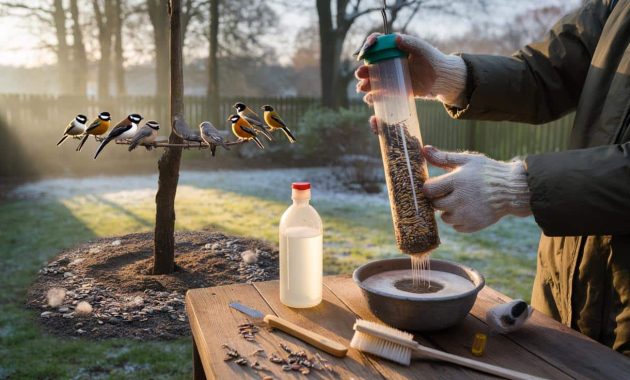
A basic cleaning routine once a week in peak winter can dramatically reduce disease risk. Here is a simple protocol:
- Wear washing-up or gardening gloves to protect yourself from germs like salmonella.
- Take the feeder down and empty all remaining seed and debris into the bin, not the compost.
- Scrub every surface with hot soapy water using a stiff brush; an old toothbrush helps reach narrow gaps.
- Rinse off the soap, then apply a solution of one part white vinegar to two parts water and leave it on for about 15 minutes.
- Rinse thoroughly with clean water to remove any residue.
| Task | Frequency in winter |
|---|---|
| Empty and scrub feeders | Once a week, or every few days during heavy use |
| Rake and remove droppings/seed under feeders | Weekly |
| Stop feeding if sickness is seen | Immediately for at least two weeks |
Why total drying matters before you refill
Putting fresh seed into a damp feeder sets you back to square one. Moisture is the spark that lets mould and bacteria take off again. After cleaning, leave the feeder to dry completely, ideally outside in a breeze or near a gentle heat source.
No visible droplets, no clammy corners: only a fully dry feeder should ever see new seed.
The forgotten “hotel”: cleaning nest boxes as well
Feeders are the canteen; nest boxes are the bedrooms. Both shape the health of local birds. By late winter, many species start scouting for spring nesting sites. A dirty, parasite-filled box can turn breeding season into an ordeal.
Old nests, new parasites
Contrary to popular belief, most small birds do not want to re-use an old nest stuffed into a box. Those cosy-looking piles of last year’s moss and feathers are often crawling with fleas, mites, ticks and larvae that survived the winter.
Before the nesting season kicks off, typically in late winter, open your boxes (where design allows) and remove the old material into a sealed bag for the bin. Give the inside a firm brush-out. A light wipe with the same vinegar solution used for feeders, followed by thorough drying, can reduce parasite pressure without leaving toxic traces.
When to stop feeding and other practical scenarios
Hygiene goes beyond cleaning gear. Sometimes the best action is to pause feeding altogether.
- If you notice several sick or dead birds, take feeders down immediately for at least two weeks.
- Clean everything before putting it back up.
- Spread food out in several places rather than creating one single crowded hotspot.
Many people worry that stopping will “doom” their regular visitors. In reality, healthy wild birds still know how to find natural food. A temporary break can interrupt disease transmission and give local populations a chance to recover.
Key terms that help make sense of bird health
A few concepts clarify what is happening at your feeders:
- Pathogen: any organism that causes disease, such as bacteria, viruses, parasites or fungi.
- Vector: a route or object that carries pathogens between animals. A dirty feeder acts as a vector.
- Reservoir: a place where pathogens survive between infections. Old seed sludge at the bottom of a tube feeder is a classic reservoir.
Understanding these terms shifts the way you see that cheerful cluster of birds. You are no longer just a generous host with a bag of seed. You are, in a quiet way, managing a small public health system for wildlife at the end of your lawn.
Handled with regular cleaning, spaced-out feeding points and a watchful eye for symptoms, your winter bird table can remain a lifeline instead of a liability. The habit that keeps them alive is not only filling the feeder, but washing it.
Originally posted 2026-03-08 11:19:37.