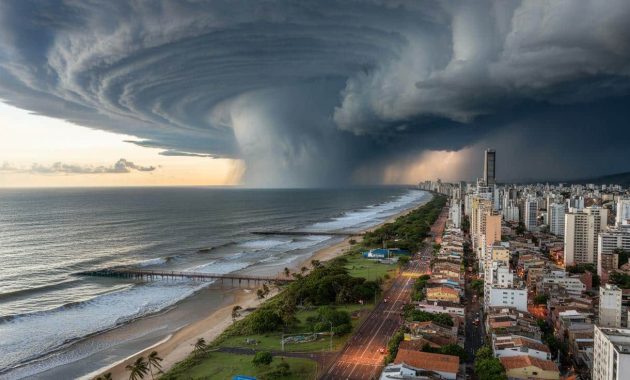
Meteorologists are tracking the development of a new cyclone off Brazil’s coast that is expected to break the suffocating heat with storms, intense downpours and sharp weather swings across the South and parts of the Southeast over the coming days.
Heatwave sets the stage for a turbulent week
Before the cyclone even forms, much of southern Brazil is sweltering. Forecasters at Meteored expect maximum temperatures close to 40°C across parts of the South and Southeast until Wednesday 28 January.
The combination of hot air and high humidity will bring a strong feeling of stuffiness from early morning. In Rio Grande do Sul, thermometers are likely to exceed 30°C before midday, with afternoon highs above 36°C through midweek, especially in the western half of the state and neighbouring areas of the South.
Forecasters say the oppressive heat between 26 January and 3 February will create ideal conditions for strong thunderstorms and the emergence of a new coastal cyclone.
By Tuesday 27 January, isolated storms are expected to pop up in Paraná. These are the first signs of a pattern shift that will intensify as the week progresses and cooler, wetter air starts to challenge the heat dome sitting over the region.
When the new cyclone is expected to form
The change really accelerates towards the end of the week. As storm systems organise along Brazil’s western border, energy and moisture from Argentina and Paraguay will feed into the developing low-pressure area.
Meteored’s current scenario points to a key window between Friday 30 January and Saturday 31 January. During this time, a new cyclone is expected to take shape over the Atlantic, off the Brazilian coast between the South and Southeast regions.
The new cyclone should form offshore between Friday and Saturday, along the stretch of coast that separates southern and southeastern Brazil.
This type of system is different from the tropical cyclones more familiar in the Northern Hemisphere. In southern Brazil, these lows are usually “extratropical cyclones” that feed on temperature contrasts between hot continental air and cooler maritime air, rather than on warm ocean water alone.
➡️ If you still throw away lemon seeds, you’re missing this surprising plant for your living room
➡️ Your heating is set to 19–20°C but you’re still cold? Why that’s normal and what you should do
➡️ Not boiled, not dry: an 11?star chef’s trick for fast, ultra?crispy baked potatoes
➡️ Why you really shouldn’t air out your home between 8am and 10am in winter
Day‑by‑day: how the weather could unfold
Thursday: storms spread from west to east
On Thursday 29 January, thunderstorms are forecast to spread across much of the South. The first organised systems should flare up in the far west of Rio Grande do Sul, near the frontier town of Uruguaiana, possibly as early as the morning.
From there, storm clusters are likely to push east and north, reaching Santa Catarina and Paraná through the day. The atmosphere will be loaded with heat and moisture, so short, violent storms with lightning, gusty winds and small hail cannot be ruled out.
Friday: heavy rain focuses on eastern areas
By Friday 30 January, the focus of the bad weather shifts toward the eastern halves of Rio Grande do Sul, Santa Catarina and Paraná. Cooler ocean air interacting with the hot, unstable inland air will help deepen the low-pressure centre near the coast.
That interaction can squeeze out intense bursts of rain and thunderstorms, especially along coastal and near-coastal zones and the northeast of Rio Grande do Sul.
Saturday: cyclone consolidates off the coast
Between Friday and Saturday 31 January, forecasts point to the cyclone consolidating offshore. As it strengthens, it may create bands of rain spiralling into the continent, with intervals of showers, thunder and possibly sharp wind gusts in exposed areas.
Rainfall will be uneven across the South: some towns may see frequent downpours while nearby areas receive much less, despite the same storm system overhead.
Which states and regions face the greatest impact?
While the cyclone stays over the Atlantic, its effects will be strongly felt on land, especially around the South. According to the current guidance, the most affected areas include:
- Rio Grande do Sul (West and Campanha) – high temperatures early in the week, followed by strong storms and possible intense episodes near the border.
- Santa Catarina (central-west) – risk of thunderstorms spreading from west to east, with bursts of heavy rain and lightning.
- Paraná (central and north-east) – potential rainfall peaks, where totals could exceed 100 mm in a few days.
Other parts of the South and parts of the Southeast may experience unstable weather, but the heaviest accumulations currently look more likely across Paraná and selected areas of Rio Grande do Sul and Santa Catarina.
Expected rainfall and flooding risk
The distribution of rain will be highly irregular. Many areas of Rio Grande do Sul will see scattered showers rather than continuous, soaking rain. Meteored projects totals of 50–80 mm by Saturday in large portions of the South.
In central and northeastern Paraná, the scenario is different. Thunderstorms may repeatedly track over similar areas, a setup known as “training storms”. There, rainfall could surpass 100 mm in a relatively short period, raising the likelihood of flash flooding and landslides on vulnerable slopes.
| Region | Projected rainfall (through Saturday) | Key concern |
|---|---|---|
| Rio Grande do Sul (most areas) | 50–80 mm | Local flooding, strong gusts, lightning |
| Northeast Rio Grande do Sul | Up to ~80 mm | Coastal squalls, rough seas, wind |
| Central & northeast Paraná | 100 mm or more | Flash floods, landslips, traffic disruption |
| Central-west Santa Catarina | 50–80 mm (locally higher) | Thunderstorms, short heavy downpours |
Why cyclones keep hitting southern Brazil
Cyclones are not rare in southern South America, particularly from late autumn to spring. What is striking for many residents is the recent sequence of strong systems affecting Brazil’s South, often followed or preceded by heatwaves.
This pattern arises when cold fronts marching up from the south collide with blocks of hot, moist tropical air. When these boundaries stall near southern Brazil, they act like a conveyor belt for low-pressure systems passing through the region and offshore.
Climate researchers are monitoring whether a warmer background climate in the South Atlantic and Amazon basin may be amplifying these contrasts, leading to more intense rain and more frequent episodes of extreme heat in the same areas.
How residents can prepare in practical terms
With several days of heat, then storms and possible flooding on the cards, small practical steps can make a difference for people living in the affected states:
- Check and clear gutters and drains so heavy rain can run off more easily.
- Avoid parking cars under trees or loose hoardings when storms are forecast.
- Charge phones and power banks ahead of time in case of brief power cuts.
- Plan travel with flexibility, especially in areas prone to flash flooding.
- Stay away from swollen rivers and avoid driving through water-covered roads.
For farmers across Rio Grande do Sul, Santa Catarina and Paraná, this sequence of intense heat followed by uneven rainfall poses particular challenges. Crops such as soybeans and maize can suffer stress from high temperatures, and strong wind or hail can damage plants just as they reach key growth stages.
On the other hand, where rain does fall in a steady pattern rather than in violent bursts, it will help replenish soil moisture in regions that have faced recent dry spells. The contrast between winners and losers, even within the same state, often depends on the precise track and timing of each storm cluster linked to the offshore cyclone.
For those watching from abroad, this new Brazilian cyclone serves as another reminder of how quickly weather extremes can stack up: from early‑morning 30°C heat to sheets of rain and strong onshore winds within a matter of days across one of South America’s most densely populated corridors.
Originally posted 2026-03-06 03:24:12.