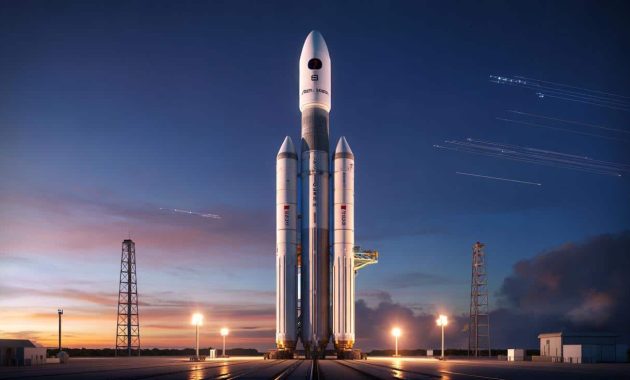
The next Ariane 6 mission, scheduled for 12 February 2026, is more than another satellite launch. It is the moment when Europe’s heavyweight rocket finally attempts to prove it can compete again in a market dominated by reusable US giants, while lofting an unusually complex payload for Amazon’s future broadband network.
A taller, heavier Ariane built for a tougher race
The mission, designated VA267, will use the Ariane 64 configuration for the first time. That means four solid rocket boosters strapped around a central core stage, rather than the two used on previous Ariane 62 flights.
This shift changes both the look and the physics of Europe’s new launcher. With the long fairing fitted, the rocket stretches to around 62 metres in height, roughly the size of a 20‑storey building. Earlier commercial Ariane 6 missions topped out at about 56 metres.
The four‑booster Ariane 64 effectively doubles the payload of Ariane 62, pushing capacity in low Earth orbit from roughly 10 tonnes to about 20 tonnes.
That extra capability is needed, because this flight must deliver 32 satellites into low Earth orbit for Amazon’s Kuiper-style “Amazon Leo” constellation. The company plans to rival Starlink in satellite broadband, and securing this contract gives Ariane 6 a valuable role in one of the most dynamic segments of the space economy.
The four booster configuration also brings significantly higher lift‑off thrust. That changes the rocket’s trajectory, steering laws and vibration profile during the first minutes of ascent. European engineers have spent years modelling these effects so that the new “monster” behaves precisely as expected when it finally clears the tower.
A new payload adapter built to carry the load
Reinforced hardware where stresses hit hardest
Less visible than the boosters, but just as critical, is the upgraded payload adapter, known internally as the ACU. This ring‑shaped structure sits at the top of the upper stage under the fairing and holds the full satellite stack during the most violent parts of flight.
For VA267, the ACU has been redesigned in a “heavy” version. Engineers thickened key composite zones to cope with the bending and shaking generated by the four‑booster ascent and the mass of 32 satellites piled on top.
Small structural tweaks to the payload adapter decide whether thousands of kilos of satellites ride smoothly to orbit or suffer damaging stresses on the way up.
➡️ Scientists Create Powerful New Form of Aluminum That Could Replace Rare Earth Metals
➡️ Goodbye, Christmas tree : meet the plant hitting florists that’s set to trend in
➡️ Experts warn dog owners: limiting walks to fast-paced marching causes frustration
Like reinforcing a load‑bearing beam in a building, the added composite layers do not change the general shape, but they drastically raise the margin against deformation. Any unexpected flexing during boost could misalign separation mechanisms or transmit shocks into delicate spacecraft.
Mission designers see this reinforced adapter as an enabler for a whole family of heavy multi‑satellite launches, from broadband constellations to Earth observation fleets.
The debut of the 20‑metre fairing
Six extra metres that change the flight profile
Another premiere on VA267 is the long fairing, a 20‑metre protective shell that shields the payload from aerodynamic loads and acoustic noise on the way through the atmosphere.
Lengthening the fairing by six metres does more than provide extra volume. It shifts the rocket’s centre of gravity and changes the aerodynamic stability of the stack at high speed.
This forces a fresh round of simulations and flight control tuning. Guidance software must account for how the taller configuration responds to wind shear and dynamic pressure, especially around the “max‑Q” phase, when airloads peak.
Only once the vehicle climbs into thin air does mission control command fairing separation. Panels swing open and fall away, revealing the dispenser structure and its 32 satellites. The timing must be precise: too early and the payload suffers heating and noise; too late and the rocket wastes fuel carrying dead weight.
Orchestrating 32 satellites without a single collision
Deploying one satellite safely is routine. Releasing 32 of them, one after another, while maintaining a clean traffic pattern is a far tougher challenge.
Each separation changes the mass and balance of the upper stage. After every release, the stage becomes lighter, so its response to control inputs evolves. That dynamic behaviour has been built into the guidance algorithms developed at ArianeGroup’s site in Les Mureaux, near Paris.
A small but crucial piece of kit helps keep everything under control: the auxiliary power unit, or APU. On Ariane 6, this device can provide a gentle, continuous thrust to stabilise the stage and maintain orientation during the deployment sequence.
The APU’s barely visible push keeps the upper stage pointed correctly, so satellites drift apart instead of drifting into each other.
The main Vinci engine, which powers the upper stage, will perform a burn shortly after separation from the core to reach the target orbit. Later, it will restart to lower the stage so that it re‑enters the atmosphere and burns up. This controlled disposal responds to growing pressure to limit space debris in crowded low Earth orbits.
Why this mission matters so much for Europe
A rocket that arrived late to a changed market
Ariane 6 was supposed to take over from Ariane 5 around 2020. Instead, a mix of technical choices, political debate and external shocks pushed its first flight back to July 2024.
Building the new ELA‑4 launch pad in Kourou, qualifying the restartable Vinci engine and handling the COVID‑19 pandemic all slowed progress. Supply chains faltered just as key tests were due. Subsystems had to be reworked, and timelines kept slipping.
The result was a four‑year gap between the original target and reality. During that period, Europe lost the heavy‑lift capacity Ariane 5 once provided, and had to rely more on foreign launchers. Meanwhile, competitors gained experience and cut costs through high launch cadence.
By the time Ariane 6 reached commercial service in 2025, the global game had shifted. Reusable rockets, mega‑constellations and aggressive pricing had become the baseline rather than future trends. VA267 is thus less a gentle step into the market and more a test of whether Europe can still shape it.
A launch industry racing towards €56 billion a year
The broader context explains the stakes. Analysts valued the orbital launch market at around €15 billion in 2025. Current projections suggest it could exceed €56 billion annually by 2035, fuelled by new constellations, military demand and data‑hungry commercial applications.
US private players such as SpaceX and Blue Origin, alongside China’s Long March family, now control a large share of launch opportunities. Smaller companies targeting micro‑launchers and dedicated rideshare services add further competition.
In response, Europe is pouring money into sovereign access to space via Ariane 6, Vega and a wave of “New Space” startups based in France, Germany and other member states. The goal is clear: retain independent launch capacity while remaining credible for commercial customers who can shop globally.
Snapshot of the competitive field in 2025:
| Actor / region | Main launcher | Orbital launches in 2025 | Market role |
| SpaceX (US) | Falcon 9 | 165 | Dominate commercial access, high cadence |
| China | Long March family | 92 | Rapidly expanding national and export offer |
| Russia | Soyuz | 17 | Stable institutional use, limited growth |
| Europe | Ariane 6, Vega | 8 | Gradual comeback, focus on autonomy |
| India | PSLV, LVM3 | 5 | Regional player, competitive for state missions |
| Japan | H‑IIA, H3 | 4 | Transition phase, industrial adjustment |
What makes Ariane 64 different from Ariane 62?
For readers used to rocket jargon, the step from “62” to “64” may sound minor. In practice, it reshapes the rocket’s role.
- Boosters: Ariane 62 has two solid boosters, Ariane 64 has four.
- Payload: around 10 tonnes to low Earth orbit for Ariane 62, roughly 20 tonnes for Ariane 64.
- Height: up to 56 m with the short fairing, 62 m with the 20‑m fairing on Ariane 64.
- Target missions: Ariane 62 focuses on institutional and medium‑mass payloads; Ariane 64 aims at heavy commercial constellations and dual‑satellite government cargos.
Later in 2026, Ariane 6 is due to receive upgraded solid boosters based on the P160C motor. This evolution, essentially a more powerful version of the current strap‑on, should raise performance without redesigning the whole vehicle. That gives planners some headroom for future payloads without opening a costly new development cycle.
Key terms that shape this mission
Several technical words keep appearing around VA267. Understanding them helps gauge what is at stake:
- Low Earth orbit (LEO): typically up to about 2,000 km altitude. Ideal for broadband constellations due to low signal latency.
- Constellation: a coordinated group of satellites designed to work together. Losing one or two units rarely kills the service, but delays have financial impact.
- Desorbitation burn: an engine firing that deliberately lowers a rocket stage so it re‑enters the atmosphere and burns up, limiting debris.
- Fairing separation: the moment the protective shell is jettisoned. A failed separation can ruin the mission even if the engines work perfectly.
Imagine a scenario where the APU fails mid‑deployment. The upper stage would start to tumble or drift. Release timings could send satellites on intersecting paths, raising collision risk and creating fragments in already‑busy orbital lanes. This is why attitude control redundancy and careful choreography are as central to the mission as raw engine power.
There are also business risks. If Ariane 64 suffers a serious anomaly on this high‑profile flight, European customers might turn permanently to foreign launchers, while consortium partners question further investment. A clean, on‑time mission, by contrast, would strengthen Europe’s bargaining position with future constellation operators who want multiple launch options.
The benefits reach beyond defence and telecoms. Reliable heavy‑lift access from European soil underpins climate monitoring satellites, navigation upgrades and scientific probes. Each successful Ariane 6 flight, starting with this 62‑metre “monster” on 12 February, helps ensure those programmes are not hostage to political shifts in Washington, Moscow or Beijing.
Originally posted 2026-03-08 13:44:53.