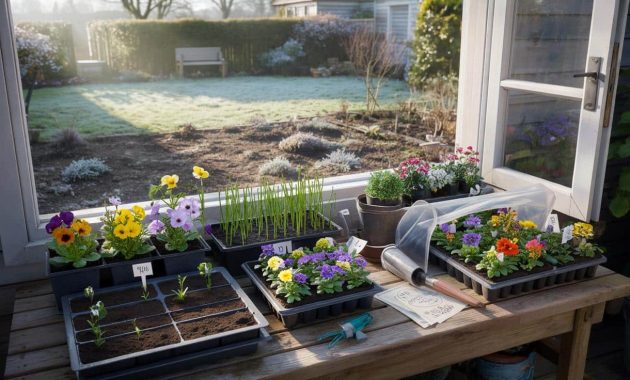
Most people ignore the garden until March, but professionals don’t. They use January’s cold, still days to start certain flowers indoors and shield key shrubs outdoors, banking an extra month of colour when spring finally breaks.
Why January is secretly the start of spring
Garden centres may look sleepy after Christmas, yet the calendar says the opposite. For many regions across the UK and northern US, January falls roughly six to ten weeks before the last frosts. That window is gold for gardeners.
Starting flower seeds six to ten weeks before the last frost lets them hit the ground running the moment temperatures rise.
While borders look bare, seeds on a bright windowsill are already forming roots and sturdy stems. By April, those early starters behave like seasoned plants, not timid seedlings. They bulk up faster, shrug off changeable weather and flower earlier and longer.
Outside, January also decides the fate of summer-flowering shrubs. Plants like mophead hydrangeas made their flower buds at the end of last summer. These buds now sit exposed on the stems, threatened by hard frost and repeated freeze–thaw cycles. A simple layer of winter mulch around the base helps stabilise soil temperature and protects the shallow roots that feed next season’s blooms.
How to use light, warmth and timing to your advantage
Indoor sowing in winter is not just about heat; light matters more. Short days and weak sun can stretch seedlings into pale, floppy threads if you are not careful.
Winter seedlings need bright, extended light and just enough warmth to stay active, not a cosy radiator that bakes them.
Place trays by a south-facing window in the northern hemisphere, or use basic LED grow lights if your home is gloomy. Aim for long bright periods, around 14–16 hours a day, so seedlings stay compact and stocky instead of racing upwards.
The compost should feel slightly moist but never soggy. A fine mist sprayer prevents seeds from being washed into clumps. Many gardeners cover their trays with a clear lid or plastic film to hold humidity during germination, then remove it as soon as the first green tips appear.
➡️ “Use was only free until 2025”: Samsung quietly drops AI end date – here’s what that really means
➡️ Meteorologists warn early February could mark a turning point in Arctic atmospheric stability
➡️ Hot tubs for people over 50, “7 out of 10 forget to factor in filter replacement every 12 months”
➡️ The overlooked bathroom vent setting experts say reduces mold by more than 40%
➡️ France still has the world’s most innovative public body in 2026, but slips to 7th in nation ranking
The 11 flowers that make January worth the effort
Among dozens of options, eleven flowers really repay being started or protected in January. Some get sown indoors, others simply need a warm blanket at their feet outdoors.
- Pansies – tough, cold-tolerant bedding plants that brighten pots and borders very early.
- Calendulas – cheerful orange and yellow daisy-style blooms that cope with cool, unsettled weather.
- Snapdragons – vertical spikes of colour that handle light frost and add height among spring bulbs.
- Wallflowers – scented, cottage-style flowers that anchor the front of borders.
- Sweet peas – climbing annuals with a strong fragrance, ideal for fences, wigwams and obelisks.
- Sweet alyssum – low, honey-scented groundcover loved by bees and useful at path edges.
- Lobelia – frothy mounds of blue or white flowers for baskets, window boxes and gaps between stones.
- Petunias – generous, trailing or bushy plantings that fill balcony boxes and patio containers with colour.
- Pelargoniums (bedding geraniums) – reliable pot plants that need an early start indoors to flower well by summer.
- Impatiens – shade-lovers that blanket dark corners and north-facing patios once frost risk has passed.
- Hydrangeas – not sown, but protected with mulch so their existing buds survive winter and bloom strongly.
Who should be sowing what in January?
| Flower | January action | Where |
|---|---|---|
| Pansies, calendulas, snapdragons, wallflowers | Start seeds | Indoors in trays or modules |
| Sweet peas | Sow in deep pots or root trainers | Cool, bright porch or unheated greenhouse |
| Sweet alyssum, lobelia, petunias | Surface-sow tiny seeds | Indoors with good light |
| Pelargoniums, impatiens | Sow early for a long season | Indoors, warm and bright |
| Hydrangeas | Mulch and protect crown | Directly in the garden |
Techniques that make winter sowing actually work
Getting seed depth right
Not all seeds want darkness. Fine seeds like petunia, lobelia and sweet alyssum often germinate best on the surface of the compost. Press them gently so they make contact but still receive light. In contrast, calendulas, pansies and snapdragons prefer a thin covering of sifted compost, roughly equal to the seed’s thickness.
Label every tray with the variety and date. Winter sowing means longer waiting times; after two weeks it is easy to forget what you started where.
Hardening off: the step people skip
The move from centrally-heated living room to chilly patio is a shock for soft seedlings. Instead of one big leap, stage it.
Two or three hours outside each day, in a sheltered, shaded spot, toughens seedlings far better than keeping them coddled indoors.
Start with a short daily visit outdoors once daytime temperatures creep above freezing. Increase the time and light exposure gradually over a week or two. Snapdragons and sweet alyssum handle this change very well and can go into beds before the last frost if they are well hardened. Tender types like impatiens must stay inside until frost risk is fully gone.
Winter mulch: a cheap insurance policy for flowers
January is also when you quietly look after hydrangeas and other flowered shrubs that already hold next season’s buds. Cold wind and bare, exposed soil let frost bite deeper, stressing roots that sit just below the surface.
Spread a 10–15 cm layer of organic material over the root zone, keeping a little clearance around the base of the stems to avoid rot. Useful materials include:
- well-dried fallen leaves
- shredded bark or pine bark
- straw or coarse hay
- shredded branches from autumn pruning
This layer works like a duvet, evening out temperature swings and slowing evaporation. Once spring arrives, you can gently tease it into the soil surface where it will rot down, feed soil life and act as a light summer mulch.
Combining January flowers for maximum impact
Thinking about combinations now saves money and time when garden centres get busy. A simple plan is to mix early structure, fragrance and long-lasting colour.
Pansies and sweet alyssum make a neat edging along a path, with snapdragons or wallflowers punctuating the back of the bed. Sweet peas can climb a simple bamboo wigwam among tulips, bringing scent just as the bulbs fade. In containers, pair trailing lobelia with petunias and pelargoniums for a full, layered look by early summer.
What gardeners mean by “last frost date”
Many seed packets refer to “sow X weeks before last frost”. This last frost date is not a fixed rule; it’s a statistical average for your area. Coastal gardens in Cornwall or the Pacific Northwest may stop freezing weeks earlier than inland or upland sites.
As a working guide, check local gardening groups or long-term weather data for your postcode. Count back six to ten weeks from that date to find your ideal January and February sowing window. If in doubt, err on the late side for tender flowers and the early side for tougher types like snapdragons and calendulas.
Two January scenarios: balcony vs. back garden
On a small city balcony, a single sunny windowsill and a few seed trays are enough. Start lobelia, petunias, pansies and pelargoniums indoors, then move them into rail planters once nights soften. Impatiens can fill the shadier corners by the door, giving you colour from eye level to floor level.
In a larger back garden, use January to rethink whole borders. Protect hydrangea bases with mulch, sow sweet peas in deep pots tucked in an unheated greenhouse, and line up trays of pansies and snapdragons under lights. By late spring, you can stitch these young plants between emerging perennials and bulbs, turning what would be bare soil into a dense, colourful patchwork.
Handled this way, January stops feeling like gardening’s dead zone. It becomes the quiet planning room where the best spring displays are already taking shape, seed by seed and mulch fork by mulch fork.
Originally posted 2026-03-08 07:12:30.