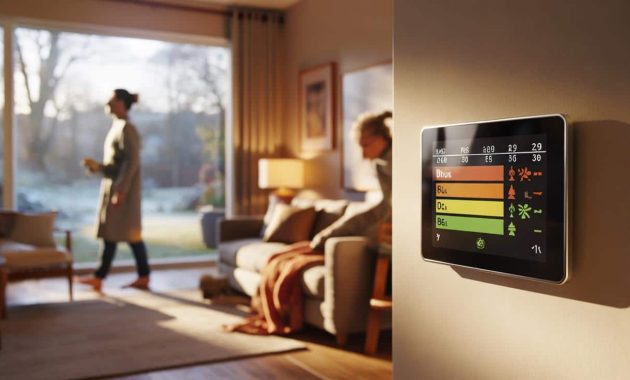
You know that tiny stab of guilt when your heating kicks on at 2 p.m. and no one’s even home? The vents sigh, the furnace wakes up, and you picture your energy bill quietly climbing in the background. Maybe you nudge the thermostat down a degree, feel vaguely virtuous for five seconds… then forget about it.
It’s such a small object on the wall, yet it decides whether you spend an extra $30 or $80 this month.
One thing HVAC engineers repeat, almost like a mantra, is that your thermostat shouldn’t follow your mood.
It should follow a schedule.
The thermostat schedule HVAC engineers wish everyone used
Ask an HVAC engineer what most people get wrong, and they’ll rarely talk about the brand of your furnace. They’ll talk about your daily rhythm. Wake time, work time, sleep time. That’s where the money leaks out.
The schedule they recommend doesn’t feel glamorous. No fancy hacks, no magic setting. Just a clear pattern: warmer when you’re home and awake, cooler when you’re gone or asleep. Repeated. Every day.
Engineers keep coming back to one core idea: *your home doesn’t need to be perfectly cozy 24/7 to feel good 90% of the time.*
Picture a pretty standard weekday. You wake at 6:30 a.m., leave around 8:00, come back at 6:00 p.m., go to bed near 11:00. HVAC pros translate that into a very specific thermostat rhythm.
For heating, they’re often aiming at something like:
- 6:00–8:00 a.m.: 68–70°F (20–21°C) while you’re getting ready
- 8:00 a.m.–5:00 p.m.: 62–65°F (16–18°C) while you’re away
- 5:00–10:30 p.m.: 68–70°F again for the evening
- 10:30 p.m.–6:00 a.m.: 62–66°F for sleeping
Energy agencies back this with hard numbers. Dropping your thermostat by about 7–10°F for eight hours a day can shave up to 10% off yearly heating costs, according to the U.S. Department of Energy. Over a winter, that’s often the difference between a painful bill and one you just pay and move on from.
It’s not wild sacrifice. It’s timing.
Why does this work so well? Because your home loses heat or gains heat at a pretty steady rate, and your system spends a lot of energy just keeping a flat line. When you allow the temperature to drift down while you’re gone or asleep, your furnace or heat pump gets real breaks.
People worry that reheating from a setback “uses more energy”. Engineers roll their eyes at that myth. The physics are blunt: the longer your home stays at a lower difference from outdoor temperature, the less energy it bleeds. The reheating spike is almost always smaller than the slow, all-day trickle of keeping everything toasty just in case.
➡️ Valentine’s Day : 52% of couples say loving animals is a major compatibility test
➡️ Feeding birds this winter? Check your seeds now – their lives depend on it
➡️ The psychological meaning behind your fear of disappointing others
➡️ France and Rafale Lose €3.6 Billion Aircraft Sale After Rival Nation Steps In
➡️ Why people who verbalize their thoughts privately improve emotional clarity
The schedule is basically a negotiation between comfort and physics. And physics usually wins.
The exact day-by-day schedule HVAC engineers actually recommend
Behind the scenes, most pros sketch out what they call a “4-period schedule”. Wake, Leave, Return, Sleep. They’ll tweak the numbers by climate, but the structure rarely changes.
For a typical heated home, the recommended baseline looks like this:
- Wake: 68–70°F (20–21°C) starting 30–60 minutes before your alarm
- Leave: 62–65°F (16–18°C) starting 30–60 minutes before you walk out
- Return: 68–70°F by the time you open the door
- Sleep: 62–66°F, kicked in about an hour before bed
For summer cooling, engineers simply flip the logic:
- Home/awake: 75–78°F (24–26°C)
- Away: 80–82°F (27–28°C)
- Night: roughly 78°F if you can tolerate it
That’s the skeleton most people need. The details depend on you.
Here’s how this plays out in real life. A family of four in a 1,900-square-foot house in Ohio let an HVAC tech reprogram their old programmable thermostat. Same furnace, same insulation, no expensive upgrades. Just a tighter schedule.
Before, they were running the house at 70°F around the clock “for the kids”. After the change, their heating pattern was:
- 5:30–7:30 a.m.: 69°F
- 7:30 a.m.–4:30 p.m.: 64°F
- 4:30–10:30 p.m.: 69°F
- 10:30 p.m.–5:30 a.m.: 64°F
First full winter with the new schedule, their gas bill dropped roughly 15%. Nothing else changed. The mom later admitted the kids never even noticed the daytime setback because they were at school.
The dramatic “comfort crisis” she imagined never showed up. The savings did.
Engineers like this schedule because it respects how heating and cooling systems actually behave. A furnace or heat pump prefers longer, steadier runs to constant on-off flickering. Long cycles are more efficient, spread the temperature more evenly, and are kinder to the equipment.
When your thermostat constantly chases tiny fluctuations around a single number, your system short-cycles and wears faster. A setback schedule, oddly enough, can give you more stable comfort when you’re home, because the system has a clear job during those windows.
Let’s be honest: nobody really does this every single day with manual adjustments. That’s why pros push people toward using the programmability they already paid for, or a smart thermostat that quietly runs the pattern in the background.
The “set and forget” isn’t laziness in this case. It’s strategy.
How to set your thermostat like an HVAC engineer (without going crazy)
The very first step is boring but decisive: write your actual daily routine on paper. What time do you really wake up? When do you really leave? When do you usually flop on the couch at night? Start with your Monday–Friday rhythm, then a separate one for weekends.
Then match that with the four periods. If you use a programmable thermostat, you’ll see something like “WAKE / LEAVE / RETURN / SLEEP” on the screen. Plug in moderate numbers, not extremes:
- Heating: test 69°F wake/return, 64°F leave/sleep
- Cooling: test 76°F home, 80°F away, 78°F sleep
Run this for a week. Notice comfort, not just the thermostat number. Are mornings chilly? Bump the “Wake” time 30 minutes earlier, not the temperature itself.
A big mistake people confess to HVAC pros is “fighting” the thermostat. They feel a little cold, slam it from 68°F to 75°F, then complain the furnace “eats energy”. The system doesn’t heat faster just because you push it higher. It only runs longer.
Another common trap: turning systems off completely when leaving for a weekend in winter. Pipes don’t love that, and neither do older houses with drafty corners. Engineers tend to suggest small setbacks for short absences, and a controlled “vacation mode” for longer ones, not giant swings.
There’s also the emotional side. Some of us grew up in homes where a warm house meant safety and care. Lowering the thermostat can feel like deprivation, even if the difference is only two degrees. Being gentle with yourself about that makes it easier to experiment instead of rebelling against your own settings.
At this point, HVAC engineers usually give a kind of pep talk. One veteran technician in Minnesota told me:
“I don’t want people freezing in their living rooms. I just want the furnace doing less work when nobody’s enjoying the heat. That’s where the money goes — to empty rooms.”
He suggests a simple checklist when dialing in your schedule:
- Start with small setbacks (3–4°F) and grow from there
- Use the “preheat” or “pre-cool” features so comfort arrives before you do
- Resist touching the thermostat for three days while you test changes
- Adjust times first, temperatures second
- For older relatives or babies, narrow the range rather than skipping setbacks entirely
One plain-truth sentence he repeated twice: *Most people never learn how to use the thermostat they already have.*
Engineers aren’t asking you to live in a parka. They’re just asking your thermostat to behave less like a light switch and more like a calendar.
Living with a smarter schedule, not a stricter house
After a few weeks on a real schedule, something odd happens. People stop talking about the thermostat and start talking about other things. The house just… works. The warmth in the morning feels intentional. The coolness at night feels like part of the routine instead of a punishment.
Some start stacking small changes on top: better curtains, a draft stopper, a thicker duvet. Not dramatic, not expensive. The schedule becomes the backbone, and everything else becomes fine-tuning around it. That’s often when the energy bills quietly shift from “stressful surprise” to just another line you’ve more or less tamed.
Engineers know they can’t crawl into every attic and redesign every system. What they can do is give you this one lever: timing. For most homes with halfway decent insulation and a working system, a good thermostat schedule is low effort, high return.
The interesting part isn’t just the money. It’s the feeling that you’re no longer at the mercy of that little box on the wall. You’re the one setting the rhythm, once, then letting it run.
If you’ve ever stared at your energy bill and thought “something has to change”, this is the place most pros quietly start.
| Key point | Detail | Value for the reader |
|---|---|---|
| Use a 4-period schedule | Divide the day into Wake, Leave, Return, Sleep with fixed temps | Gives structure and repeatable savings without daily micromanagement |
| Apply modest setbacks | Lower heating 5–10°F when away/asleep, raise cooling 3–4°F | Can cut annual bills by up to 10% while staying comfortable |
| Adjust times, not just temps | Shift when heating or cooling starts so comfort matches your routine | Improves comfort without wasting energy on empty rooms |
FAQ:
- Question 1What thermostat temperature do HVAC engineers recommend in winter?Most target around 68–70°F (20–21°C) when you’re home and awake, and 62–66°F (16–19°C) while you’re away or sleeping, adjusted slightly for your comfort and insulation.
- Question 2Does turning the heat down really save money if I have to reheat the house later?Yes. The longer your home sits at a lower temperature, the less heat it loses to the outdoors, so the total energy used is usually lower than keeping it warm all day.
- Question 3How often should I change my thermostat settings?Ideally, you set a daily schedule once and only tweak it when your routine changes, like a new job schedule or a season shift. Constant manual changes tend to waste energy.
- Question 4What about pets — can I still use setbacks?Most healthy pets are fine with moderate setbacks, like 64–66°F in winter or up to 80°F in summer. If your vet suggests a tighter range, just reduce the setback size, not the schedule itself.
- Question 5Do I need a smart thermostat to follow an HVAC-style schedule?No. Any basic programmable thermostat with four periods per day can do it. Smart models just automate learning your habits and can adjust when you’re away unexpectedly.
Originally posted 2026-03-05 01:47:10.