Hidden in the Westerwald mountains, far from any known Roman town or Germanic settlement, a huge stash of ancient coins has forced experts to rethink what they thought they knew about life on Rome’s northern fringe.
A Roman hoard turns up where Rome supposedly wasn’t
The find was made near the small town of Herschbach, in western Germany’s Westerwald range. There, a hobby detectorist picked up a signal that turned into one of the largest Roman coin hoards ever found beyond the formal frontiers of the empire.
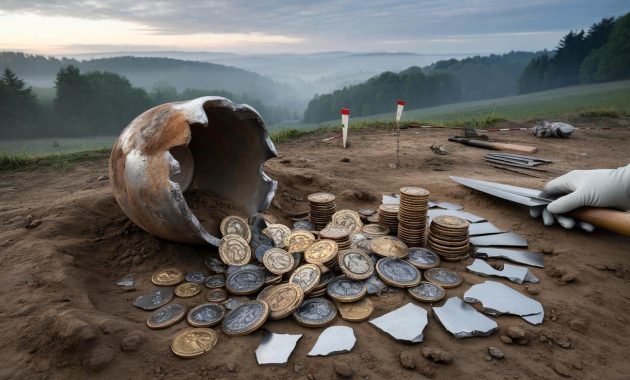
Archaeologists called to the site uncovered a broken ceramic vessel buried in the rocky soil. Inside were exactly 2,940 Roman coins, dating from roughly AD 241 to 269, along with several hundred pieces of silver fragments whose original function remains uncertain.
Just 18 kilometres beyond the Roman defensive lines, a mountain slope has produced a treasure that should not, on paper, be there at all.
The location is the real puzzle. This is not a river crossing, not a known trading post, and not part of any documented tribal centre. Yet it now holds one of the largest caches of Roman money found outside the empire’s borders.
What the coins tell us about their age and origin
The hoard dates to the mid-third century AD, a time when the Roman Empire was struggling with internal crises, invasions and breakaway states. The coins appear to have been buried in the 270s, according to excavation supervisor Timo Lang from the state archaeology service in Rhineland-Palatinate.
Most of the pieces are low-value silver-alloy coins, typical of the inflation-ridden era. Some were minted in Cologne, at the time part of the so‑called Gallic Empire, a short-lived rival state that split from Rome between about AD 260 and 274.
This Gallic Empire controlled parts of modern-day France, Belgium and Germany. Cologne played an important role as a mint, stamping new coins to pay soldiers and officials. Yet Herschbach and the Westerwald mountains lay beyond its solidly administered, urbanised zone.
The coins fit the Gallic Empire on a map of power, but the hiding place sits awkwardly between history’s known lines.
➡️ Boiling lemon peel, cinnamon and ginger : why people recommend it and what it’s really for
➡️ Scratched glass cooktops can look nearly new again without replacing the surface
➡️ Semaglutide May Reverse Damage Caused by Osteoarthritis, Study Suggests : ScienceAlert
➡️ Over 55 and choosing a larger jacuzzi, “you may be heating 500 extra gallons unnecessarily”
➡️ Many people feed birds in winter… but forget this other habit just as vital for their survival
Why this hoard is so unusual
Roman coins do turn up outside the empire, but usually in small numbers. They are often linked to trade, gifts or looting. Timo Lang notes that numismatic hoards beyond Roman borders usually hold dozens or at most a few hundred pieces.
In contrast, nearly 3,000 coins in one spot is exceptional. Lang knows of only one comparable case, a hoard found in Poland. That makes the Westerwald treasure an international outlier.
- Location: Herschbach area, Westerwald mountains, western Germany
- Distance from Roman frontier: about 18 km beyond defensive lines
- Period of coins: AD 241–269
- Likely burial date: around the 270s
- Number of coins: 2,940, plus silver fragments
Did Rome pay for protection beyond its borders?
One leading idea involves politics rather than pure treasure. During the mid-third century, Rome and the breakaway Gallic Empire faced pressure from Germanic groups across the Rhine. Paying local elites for peace, alliance or neutrality was a common tool of diplomacy.
Under this scenario, a regional Germanic leader or group could have received the money as a subsidy. The coins might represent instalments of payoffs, pensions for warriors, or the liquid savings of a client chieftain working with the Gallic regime.
Such payments usually flowed along established contact zones: river valleys, market sites and front-line forts. That still leaves a problem. Herschbach is not a documented power centre, and the burial site sits in rugged, forested ground rather than prime farmland or a busy road junction.
The hoard fits a known Roman habit – paying neighbours to stay friendly – yet the chosen hiding place feels like someone stepping off the map on purpose.
A hoard buried in a hurry – or planned carefully?
The broken ceramic pot suggests a deliberate act of concealment. Someone filled a vessel with coins and fragments of silver, carried it into the hills and buried it deep enough to outlast casual ploughing or erosion. That person, or their heirs, never came back for it.
Archaeologists are now studying the silver fragments. They might be chopped jewellery, pieces of larger objects used as bullion or ritual offerings. Their shape and wear could show whether they were daily currency or part of a more symbolic deposit.
In many Roman and Germanic contexts, hoards represent savings hidden during times of danger. Yet some deposits were never intended for recovery and could have had religious or status meanings. The Westerwald case sits uncomfortably on that line: too valuable to throw away, but buried in a spot that feels almost secretive.
What this changes about the Roman–Germanic border
History books often draw Rome’s frontier as a clear line of walls, ditches and watchtowers, with “civilisation” on one side and “barbarians” on the other. Finds like the Westerwald hoard challenge that tidy picture.
Roman money, objects and ideas circulated far beyond official boundaries. Germanic warriors served in Roman units. Traders moved goods both directions. Local chiefs shifted allegiance depending on who paid better or posed the greatest threat.
The hoard hints that the landscape beyond the frontier was alive with unofficial deals, quiet networks and local power brokers who left little written trace. Instead of a sharp border, the region might have been a thick zone of mixed influence where Roman coins and Germanic customs overlapped.
| Aspect | Traditional view | What the hoard suggests |
|---|---|---|
| Frontier | Firm line between Rome and “barbarians” | Wide contact zone with shifting loyalties |
| Roman money | Mainly used inside the empire | Acted as diplomacy, pay and prestige beyond borders |
| Remote areas | Marginal to big political events | Could host hidden deals, payments or refuges |
Key terms that help make sense of the find
Archaeologists call this type of find a “hoard” – a deliberate collection of valuables hidden or stored in one place. Unlike scattered finds, hoards are often tied to a specific moment of crisis, migration or major life choice.
The field that studies coins is known as numismatics. By looking at the emperor’s portrait, mint marks and metal content, numismatists can narrow down where and when each piece was made. In this case, those details point strongly to the mid-third century turmoil and the short-lived Gallic Empire.
What this means for future digs and weekend detectorists
The Westerwald case also carries a practical message for both professionals and hobbyists. Remote, wooded zones once considered archaeologically “quiet” can hold major surprises, especially where ancient frontiers once ran.
For metal detectorists, the find is a reminder of the legal and ethical side of the hobby. In much of Germany and across Europe, reporting finds quickly, avoiding unlicensed digging and cooperating with authorities can turn a lucky beep into genuine research that reshapes regional history.
Archaeologists, for their part, now face a fresh challenge: tracking similar “off-grid” hoards that may sit unreported in private collections or still buried in other mountain ranges, waiting for the right combination of curiosity, patience and chance to bring them to light.
Originally posted 2026-03-10 09:57:42.