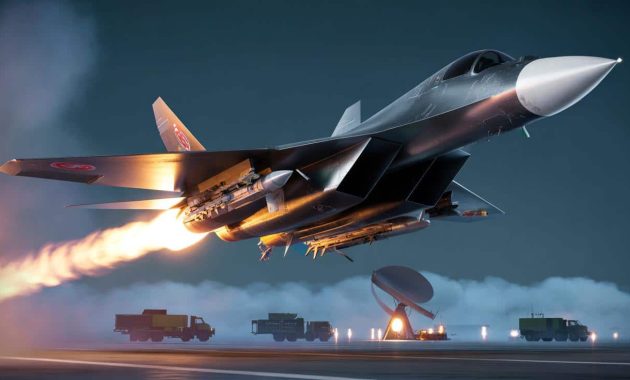
Moscow has released material that appears to show the Su-57 configured for radar-hunting missions, with anti-radiation missiles tucked inside its weapons bay. The setup suggests a more aggressive role: slipping past sensors, striking the eyes of an air-defence network, and opening a lane for follow-on aircraft.
A stealth strike profile built for radar suppression
The highlight is the Kh-58UShKE, a modern anti-radiation missile optimised to home in on hostile emitters. Russian sources list its speed at roughly Mach 3.6 and a range beyond 200 km, placing most long-range surveillance radars within reach. Folding fins allow carriage inside the Su-57’s internal bay to reduce radar signature during ingress.
If confirmed, that internal carriage matters. Anti-radiation missiles traditionally sit under the wings, which undermines stealth and limits survivability near dense surface-to-air missile belts. By keeping the bay closed until launch, the Su-57 could hold its low-observable profile longer, then sprint a missile toward a radar as soon as the emitter exposes itself.
Internal carriage of high-speed anti-radiation missiles would let the Su-57 hunt surveillance radars without giving away its presence too early.
About that Mach 3.6 claim
Mach 3.6 translates to around 4,400 km/h at altitude. At that speed, a 200 km shot takes minutes, not tens of minutes. That compresses the defender’s decision loop. Radar crews often use “blink” tactics, cycling emissions on and off to break a missile’s lock. A fast, long-legged missile narrows that window and punishes hesitation.
Guidance is crucial. Modern anti-radiation seekers can remember the last known position if the radar shuts down, then reacquire when it lights up again. Some variants also accept mid-course updates from the launching aircraft or a networked asset, which helps against mobile systems. Russia rarely discloses seeker details, so the exact sophistication here remains unclear.
Combat lessons from Ukraine feed the design
The Su-57 has turned up in multiple reports on the Ukraine war, usually in stand-off roles. Russian media claim the jet has fired long-range precision weapons while staying on the Russian side of the front. That is consistent with a cautious approach that still yields data on sensors, datalinks and mission systems. A radar-hunting loadout would align with those lessons: probe air defences, record their behaviour, hit key emitters when an opening appears.
Ukraine’s integrated air-defence system mixes legacy Soviet kit with Western-supplied missiles and modern command networks. It forces Russian aircraft to fly conservatively. Any credible move toward stealthy suppression tools would aim to unclench that defensive grip, at least locally and temporarily.
Production and exports: the long game
Russia says production at Komsomolsk-on-Amur has been upgraded to raise output after 2024. Export chatter has grown louder as Moscow courts buyers seeking fifth‑generation features without Western strings. Algeria frequently appears in reporting. India, a long-time Russian partner, has weighed options after stepping back from earlier Su-57 co-development, and remains a high-stakes prospect.
| Period | Signal |
| 2024 | Factory modernisation and talk of higher delivery rates |
| Mid‑2025 | Renewed export messaging and pitches to traditional partners |
| Late‑2025 | Reports of initial export preparations, details not public |
Two constraints hover over all this. First, engines. Russia is transitioning from AL‑41F1 powerplants to the “Izdeliye 30,” expected to improve thrust and efficiency; the pace of that shift will shape performance. Second, sanctions. Avionics supply, precision machining and composite production face pressure, which can slow ramp-ups and complicate support packages for foreign buyers.
➡️ Over 65 and feeling more cautious? Neuroscience explains the change
➡️ Spahis: history, role and impact in military history
➡️ Goodbye traditional kitchen cabinets: this cheaper new trend won’t warp, swell, or grow mould
➡️ They stopped drinking, yet their liver won’t heal: science has finally figured out why
Western programmes face their own integration gap
NATO relies on a different mix. The EA‑18G Growler with AARGM‑ER remains the mainstay for suppression of enemy air defences, backed by standoff munitions, cyber effects and decoys. The F‑35 programme is integrating AARGM‑ER in steps, with internal carriage and software maturity tied to later blocks. The F‑22 continues to receive incremental updates but does not currently field a dedicated internal anti‑radiation weapon.
The net effect is not a vacuum, but a gap. Western forces can hit radars, just often from non‑stealth platforms or with external stores that swell signature. If the Su‑57 truly carries a long‑range anti‑radiation missile internally today, Russia would be first to field that specific combination. The scale of the advantage would depend on missile seeker quality, the jet’s sensor fusion, and the availability of enough aircraft to sustain tempo.
The contest is shifting from pure platform stealth to emissions warfare: who sees first, who shoots first, and who dares to radiate.
What this means for air-defence networks
Modern integrated air defence depends on linking radars, infrared sensors, passive detection, and command nodes. Knock out key emitters, and you dim the picture for interceptors and long-range missiles. A stealth jet with internal anti-radiation missiles adds a sharper scalpel to that task.
- Mobile systems face pressure to keep moving, which erodes coverage consistency and raises crew fatigue.
- Emission control helps, but silent batteries cannot guide long‑range shots, reducing engagement envelopes.
- Decoys and distributed sensors gain value, forcing attackers to waste missiles or reveal their position.
- Counter‑SEAD tactics like rapid radar pop‑ups, remote emitters and fake target generators will spread further.
Five questions that decide the real impact
Several unresolved factors will determine whether this configuration becomes a strategic headache or a niche tool:
- Missile seeker performance against low‑probability‑of‑intercept radars
- Networking: mid‑course updates, data‑links and off‑board cues
- Electronic warfare integration inside the Su‑57’s mission system
- Production tempo and sustainment under sanctions
- Pilot training hours for complex, high‑risk SEAD profiles
How anti-radiation duels play out in practice
An anti‑radiation shot starts with detection of an emitter’s signature. The launch aircraft calculates a solution, fires, then updates the missile as needed. The defender can shut down, relocate, or hand off tracking to another radar. If the missile has memory and updates, the defender risks lighting up again within its lethal basket. If not, the shot may waste. Both sides run decoys: inflatable launchers, fake emitters, and digital radio‑frequency memory jammers that spoof bearings.
For planners, small improvements compound. A stealthier launch platform reduces detection range. A faster missile trims reaction time. A better seeker rides out radar shutdowns. Together, they lower the defender’s margin for error. The inverse holds too: better passive sensors, multi‑static radar networks, and agile command nodes can blunt the attacker’s edge.
Where the UK and NATO adjust next
Europe is already investing in electronic attack and decoy swarms. The UK’s SPEAR‑EW and remote carriers aim to saturate sensors and pull radars into the open. Pairing those with long‑range anti‑radiation options on F‑35 and Typhoon, plus robust cyber and space ISR, will matter more as adversaries lean into stealthy SEAD profiles. Training against pop‑up emitters and mobile SAM ambushes needs higher tempo, not just better kit.
Term to know: anti‑radiation missile (ARM). An ARM homes on radio emissions, typically from search or fire‑control radars. Modern ARMs use wideband receivers, inertial navigation and datalink updates. The best can prosecute a target that briefly shuts down, then reacquire when it radiates again.
Risk to watch: misidentification in crowded spectrum. Civilian infrastructure and friendly emitters complicate targeting. Tight rules of engagement, emitter libraries and geolocation fidelity are critical to prevent fratricide and collateral effects.
Originally posted 2026-03-08 06:34:19.