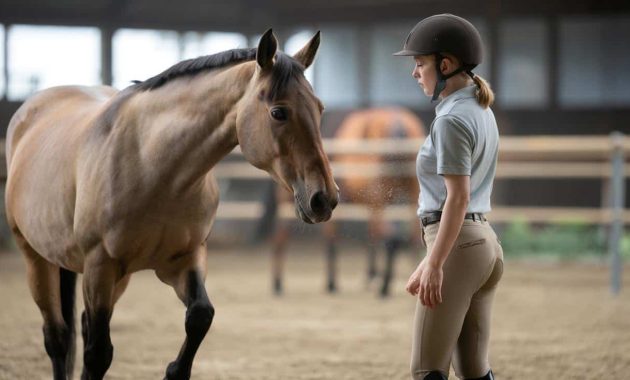
New research from French scientists suggests that horses don’t just react to our body language or tone of voice. They also respond to chemicals we emit when we’re afraid, subtly shifting their behaviour and even their heartbeat in line with our emotional state.
Humans leak emotions through scent
Human emotions don’t stop at facial expressions or trembling hands. They also leave a trace in our sweat. When we feel intense fear, our bodies release a particular mix of volatile compounds through the skin, especially under the arms.
These chemical signatures are often below our own threshold of perception. We rarely think of humans as having meaningful “smell signals”. For many animals, though, those signals form a constant, rich stream of information.
Horses appear to treat human body odour as emotional data, not just background smell.
This idea has been discussed for dogs for several years. The new study suggests that horses are just as finely tuned, and that they adjust their behaviour depending on whether a nearby human is terrified, relaxed or simply neutral.
A tightly controlled experiment with 43 mares
The research team from the French Institute for Horses and Riding (IFCE) and INRAE set up a strict protocol to test this phenomenon. They worked with 43 mares already accustomed to human handling, which reduced the risk of random fear responses.
Collecting the “smell of fear”
To create emotional odour samples, volunteers wore cotton pads under their armpits while watching carefully selected videos:
- Fear: the horror film “Sinister”
- Joy: a mix of musical comedies and comedy sketches
- Neutral: emotionally flat content
Each video segment lasted 20 minutes, giving enough time for the body to produce measurable sweat and volatile compounds. The volunteers handled the pads themselves and the samples were frozen at -80°C to preserve the molecules.
This is a crucial point: the horses never met the human donors during the tests, and there was no visual or sound signal linked to the recorded emotions. Only the scent was allowed to “speak”.
➡️ Winter storm warning: Up to 58 cm of snow could cause local shortages by blocking deliveries
➡️ Banana peels in the garden: they only boost plants if you put them in this exact spot
➡️ A cosmic treasure in France: this meteorite contains grains older than the Sun
➡️ Here’s how much time you really need to spend with your cat every day
➡️ Windows: the clever Scandinavian trick to block cold air
➡️ In Mongolia, automatic cameras film “the rarest bear in the world” with her cub
How the horses were tested
During the experiments, the frozen pads were fixed in small nets near the horses’ nostrils. The animals then went through a series of standardised tests, all while researchers recorded their heart rate and collected saliva for hormone analysis.
The behavioural tests included:
- An approach test with a stationary human in the arena
- A grooming session to assess tolerance to touch and proximity
- A “startle” test with a suddenly opened umbrella
- A reaction test to an unfamiliar object
At the same time, the scientists measured cortisol in saliva, a hormone linked to longer-lasting stress. This dual approach helped differentiate a sharp emotional reaction from a more chronic stress response.
When humans are afraid, horses get warier
The data point in one clear direction: horses behave differently when they are breathing in the scent of human fear.
Faced with fear odours, the mares became more vigilant, more cautious and less willing to approach people.
During the approach test, the animals exposed to fear odours were significantly less inclined to move towards a human, even if that person was familiar. Their steps slowed or stopped earlier, and they often kept their distance.
In grooming sessions, physical contact was shorter and less relaxed. Some horses tensed, shifted away or seemed less accepting of touch. That shift suggests not just a momentary startle, but a change in their willingness to share close space with humans.
Body signs and heartbeat changes
The fear odours also magnified reactions during the startle tests. The horses jumped more sharply when the umbrella opened or when a strange object appeared.
The researchers observed classic signs associated with equine fear:
- Ears pinned back or flicking sharply
- Muscle tension along the neck and back
- Stepping backwards or sideways
- Intense, fixed staring at the stimulus
Heart monitors told a similar story. The horses’ heart rates increased in the presence of the fear scent, indicating quick activation of the autonomic nervous system.
Interestingly, cortisol levels in saliva did not change in a significant way. That suggests a fast, adaptive emotional response rather than long-term stress. The horse senses something that signals “danger”, shifts into a cautious mode, and then may return to baseline.
Evidence of emotional contagion between species
Scientists describe this phenomenon as “emotional contagion” between species. One individual’s state affects another’s, even without explicit signals like shouting, pulling on the reins or sudden gestures.
The horse does not need to see a threat. The human’s fear odour alone can push it into a defensive mindset.
Emotional contagion has already been documented within species, especially in social animals. Dogs, for instance, are known to respond to human stress scents. With horses, the evidence remained limited until now.
The study adds weight to the idea that horses can decode emotional information from other species using their advanced sense of smell. Unlike humans, they have a functioning vomeronasal organ, which detects certain chemicals that our noses usually miss.
As prey animals, horses evolved to pay close attention to subtle cues that might signal danger. A trembling hand, a tightening jaw, and now we know, the odour of human fear, all feed into their risk assessment.
What this means for riding, training and safety
The practical consequences go far beyond academic interest. If horses react strongly to human fear scent, every nervous rider or anxious vet visit takes on a new dimension.
An uneasy human is not just less skilled; they may be chemically telling the horse that something is wrong.
For instructors, that means working on the rider’s inner state is not a luxury add-on. It becomes part of basic safety. A tense beginner trying to “fake confidence” might still be broadcasting fear through sweat, making the horse more reactive and less predictable.
In riding schools, situations like first jumps, hacking in open country or loading into a trailer often create strong emotions on both sides. If the horse is picking up human fear through smell, spirals of mutual anxiety become easier to understand.
| Human state | Likely horse response | Practical risk |
|---|---|---|
| Calm, confident | More willing to approach and be handled | Lower risk of spooking or refusal |
| Anxious, fearful | Increased vigilance, avoidance, stronger startle | Higher risk of bolting, rearing or sudden movements |
| Neutral, focused | Stable behaviour, easier learning | Better conditions for training and medical care |
Rethinking training and veterinary care
For riding instructors, groomers and vets, emotional self-management becomes a technical skill. Breathing exercises before handling a nervous horse, planning quiet, predictable routines, and avoiding rushed appointments could all reduce fear odour production.
The study’s authors argue that equestrian teaching should include modules on human emotion regulation, not just on seat, hands and leg aids. A calm rider communicates safety both through their body and through invisible chemical cues.
Veterinary procedures give another concrete example. Horses often associate injections or examinations with discomfort. If the vet or handler arrives already stressed, the horse might smell that tension before any needle appears, priming it for resistance.
How horses sense what we cannot smell
From a biological point of view, horses are equipped for this kind of invisible conversation. Their nasal cavity is more complex than ours, and the vomeronasal organ sits above the palate, connected to ducts in the mouth and nose.
When a horse curls its upper lip and lifts its head in a “flehmen” response, it is actively drawing odours towards this organ. While this behaviour is most often seen with pheromones, the same sensory system can process emotional odours.
Humans, by contrast, rely heavily on sight and sound. Our sense of smell is weaker, and much of what our body emits never reaches our own awareness. That asymmetry means the horse senses a layer of the relationship that the rider simply cannot perceive directly.
Practical scenarios riders can relate to
Imagine a teenager about to canter for the first time. Her hands are slightly shaky, her breathing fast. Even if she smiles for her instructor, her sweat is carrying a clear message: “I’m scared.” The horse, catching this signal, raises its head, tightens its back and becomes quicker in stride. The ride feels less safe, confirming the rider’s fear.
Or picture a rescue horse meeting a new owner. The human is emotional, torn between excitement and worry. Their scent may express this turmoil. A sensitive horse could hesitate to approach, not because it dislikes the person, but because the smell suggests instability or danger.
Key terms worth unpacking
Emotional contagion describes a process where one individual’s emotional state triggers a similar state in another. In this context, the horse shifts towards fear or vigilance in echo of the human’s fear.
Cortisol is sometimes called the “stress hormone”. High levels over time can harm health, but a single emotional episode does not always change cortisol. The study’s lack of cortisol spikes suggests short-lived reactions rather than long-term distress in the horses.
Volatile organic compounds are molecules that evaporate easily at room temperature. Many smells, from perfume to body odour, fall into this category. In fear, the mix of these compounds in sweat and breath changes.
What comes next for research on horse–human emotions
The French team plans to widen their work to other emotions such as sadness, anger or disgust. One open question is whether horses react differently to these odours, or whether they mainly distinguish between “safe” and “unsafe” states.
Another angle concerns reciprocity. Do horses themselves release emotional odours that humans could, with training or technology, detect and interpret? Such findings could reshape how we assess equine welfare, signalling early discomfort before visible behaviour changes.
For now, the study adds a new dimension to a familiar saying in stables: “The horse is your mirror.” That mirror might be reflecting far more than posture and confidence; it may also be reading, quite literally, the smell of your fear.
Originally posted 2026-03-05 01:47:46.