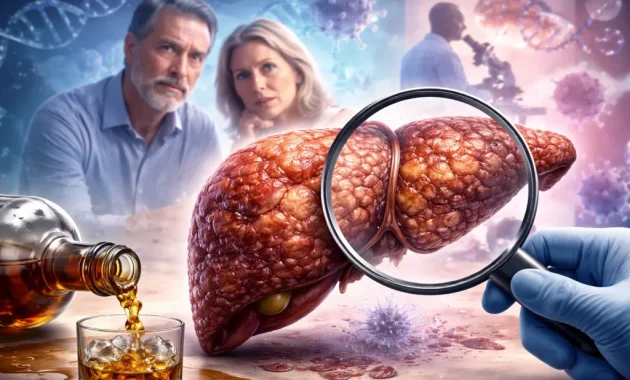
The blood tests drift. Fatigue lingers. And the liver stays quiet.
Doctors have long seen patients who quit alcohol yet keep getting worse. The scans show damage. The organ should rebound. It doesn’t. A new line of research now points to a hidden lock inside liver cells that keeps repair on hold, even when the last drink is far behind.
A quiet champion with limits
The liver is remarkable at bouncing back. After injury or surgery, it can regrow much of its lost mass. It does this by switching on a developmental programme, letting mature cells divide, then return to duty. In most cases, that cycle hums along.
Severe alcohol-related disease changes the script. In advanced hepatitis or cirrhosis, tissue scarring and inflammation build up. Patients stop drinking, yet the organ fails to regenerate. Many end up on transplant lists. Clinicians have struggled to explain the stall. The damage alone didn’t tell the whole story.
Researchers now trace the failure not to dead cells, but to a jam in how surviving cells make and position their proteins.
The bottleneck inside RNA splicing
A team from the University of Illinois, working with Duke University and the Chan Zuckerberg Biohub Chicago, dug into patient samples and animal models. Their attention turned to RNA splicing, the editing step that shapes raw RNA into instructions for protein building.
In alcohol-damaged livers, the team found widespread mis-splicing across thousands of genes. Crucial messages came out mangled. Proteins arrived incomplete or in the wrong place. That is a disaster when a tissue needs to repair with speed and precision.
One regulator sits at the centre of the storm: ESRP2, a splicing factor that helps cells switch between growth and maturity programmes. Levels of ESRP2 fell sharply in diseased liver cells. Without it, regeneration signals lost their punch.
When keys can’t reach the lock
The study singled out proteins such as TCF4 and SLK. These proteins should move into the nucleus to switch on repair pathways. With ESRP2 depleted, they fail to get there. The cell stays stuck in an awkward mid-state. It no longer works like a healthy adult cell, yet it cannot divide properly to replace damaged tissue.
The liver isn’t refusing to heal. It has been stripped of the molecular tools needed to start the job.
➡️ “After 60, I needed more structure”: why my brain asked for it
➡️ If your garden requires constant correction, the foundation may be unstable
➡️ Restoring sight without major surgery : how a clear gel is reshaping damaged eyes
➡️ How a colander over your mixer bowl catches flour dust during baking
➡️ “I work in performance monitoring and earn $66,800 a year”
Inflammation keeps the brakes on
Why does ESRP2 drop in the first place? The answer sits in the inflammatory soup of a liver wounded by years of alcohol. Chronic inflammation boosts cytokines, including TGF-β, a potent signal that pushes cells toward scarring and quiescence. TGF-β also suppresses ESRP2 expression, the study shows. So even after alcohol stops, the biochemical weather stays unfriendly to repair.
The team tested an inhibitor of the TGF-β pathway in cultured liver cells. ESRP2 levels rose. Splicing patterns normalised. Key proteins found their way into the nucleus again. It’s a lab result, not a cure. But it sets out a rational path for drug development that aims to unlock regeneration rather than only slow damage.
What this could mean for patients
For people living with alcohol-related liver disease, abstinence remains the first step. It reduces ongoing injury and improves survival odds. Yet, as many families know, stopping drinking does not always flip the switch to healing. A targeted way to rearm the repair toolkit could change trajectories, shorten hospital stays, and take pressure off transplant services.
- Potential targets: raise ESRP2, correct mis-splicing, and reduce TGF-β signalling without shutting down necessary immune functions.
- Clinical markers: track inflammatory cytokines, splicing signatures, and nuclear localisation of regeneration proteins in biopsies.
- Near-term goal: small trials to test safety and biological activity of TGF-β pathway blockers in well-defined patient groups.
How regeneration differs when things work vs when they don’t
| Feature | Healthy regeneration | Alcohol-injured, ESRP2-low |
|---|---|---|
| ESRP2 level | Balanced, supports switching between growth and maturity | Suppressed, cells can’t switch properly |
| TGF-β signalling | Controlled, allows repair without fibrosis | High, promotes scarring and quiescence |
| RNA splicing | Accurate, proteins built to plan | Faulty, many proteins truncated or misdirected |
| TCF4/SLK location | In the nucleus, activating repair genes | Stuck outside the nucleus, signals fail to fire |
| Outcome | Tissue regrows, function recovers | Cells frozen in limbo, function declines |
What the NHS should watch for next
Drug candidates that modulate TGF-β already exist in oncology and fibrosis trials. Any use in liver disease will need careful dosing, since TGF-β also helps control wound healing and immunity. The sweet spot is a dial, not a switch. Biomarkers that read out splicing repair in real time would help clinicians steer treatment and avoid blunt immunosuppression.
Pathology services could start to standardise assays for splicing factors and nuclear localisation of repair proteins in biopsy material. If those measures track outcomes, they can guide trial enrolment and stratify risk.
Signals to watch after quitting alcohol
Clinicians often look beyond liver enzymes once heavy drinking stops. Signs of true recovery include improving albumin, stabilising clotting times, shrinking spleen size on imaging, and better exercise tolerance. If numbers drift or ascites returns despite abstinence, hidden inflammatory signalling may be in play. That is the group most likely to benefit from a pathway-correcting therapy.
Abstinence opens the door. Calming TGF-β and fixing splicing may be what gets patients through it.
Extra context for readers
RNA splicing, in plain terms, is editing. Cells cut and paste sections of a message to make different protein versions. During repair, they need the “growth” versions. When the editor, ESRP2, goes missing, the script comes out wrong. That creates proteins that cannot reach the nucleus or bind the right partners. The cell hears the alarm but cannot organise a response.
There are risks with TGF-β blockers. Too much suppression could raise infection risk or impair normal scar formation. On the upside, a measured approach could reduce fibrosis and rekindle regeneration, which would improve quality of life and delay or avoid transplantation. Combination strategies make sense: treat inflammation, support nutrition, manage complications, and tune the splicing machinery back toward repair.
A practical take for patients and families
Ask your care team about inflammatory drivers and regenerative markers, not just enzyme peaks. Nutrition, vaccinations, and treatment of gut bacteria overgrowth can reduce inflammatory noise. Future trials may add a splicing or TGF-β modulator to that package. If you feel stuck after quitting, you’re not imagining it. Biology sometimes needs a nudge to remember how to heal.
Originally posted 2026-03-04 01:18:44.