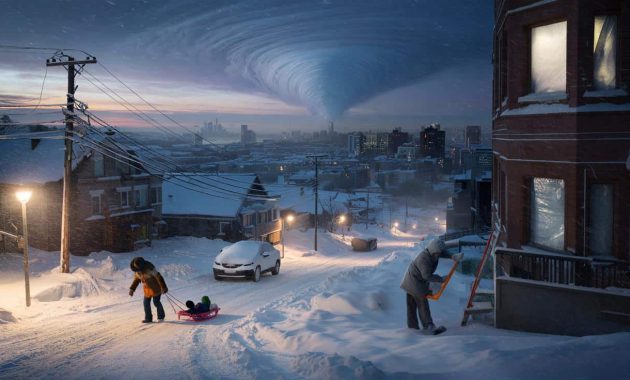
The message hit people’s phones before dawn: “Life-threatening cold. Avoid travel.”
Outside, the streetlights caught a snow haze being ripped sideways by the wind, the kind that makes even familiar corners look a bit alien. On social media, videos rolled in from Minnesota, Quebec, Berlin, Warsaw – boiling water thrown into the air turning to instant vapor, frozen eyelashes, car doors sealed shut by icy armor. Some users captioned it with burning planet emojis, others with eye-rolls and “Welcome to winter, folks.”
In kitchens and offices and group chats, the same question floated around: is this terrifying polar plunge the smoking gun of a runaway climate emergency, or just a brutal reminder of how soft we’ve become about what winter used to be?
Nobody quite agrees on the answer.
The polar vortex is wobbling again – and it’s heading straight for us
At the core of the story is a piece of the atmosphere most people never think about: the polar vortex. High above the Arctic, this spinning whirl of bitterly cold air usually stays locked in place, like a lid on a freezer. Now, in February, that lid is cracking. Meteorologists talk about a “sudden stratospheric warming” event, where the air above the pole heats up rapidly and shoves the vortex out of its usual orbit.
Down on the ground, that abstract wobble becomes a wall of cold knifing into Europe, North America and parts of Asia. Flights will be canceled, pipes will burst, and power grids will creak.
If this all sounds familiar, it’s because we’ve seen versions of it before. In early 2021, a polar vortex disruption sent Arctic air plunging into Texas, killing at least 246 people and leaving millions without power for days. Videos of ceiling fans dripping icicles in Houston became instant climate horror imagery.
This time, model runs from major forecasting centers show a similar pattern: a fractured vortex, lobes of cold air breaking away and sliding south over densely populated zones. The warnings are already getting sharper as the event draws closer. Supermarket shelves start to thin out. Parents quietly calculate how many days of school closures they can juggle.
Climate scientists are split, and not just on Twitter. Some argue that as the Arctic warms roughly four times faster than the rest of the planet, the temperature difference between pole and mid-latitudes weakens the jet stream. That makes it wobblier, more prone to those dramatic dips that spill frigid air south. Others say the data is too noisy, that we’re over-reading a few headline-grabbing winters.
The debate is real science, but it’s also about stories. One camp sees each brutal cold blast as more evidence that **climate chaos** is scrambling all the rules. The other warns that cherry-picking extreme events – hot or cold – is a lousy way to understand long-term warming.
Are we in crisis – or just shocked by what winter really is?
Day to day, the way people process this isn’t through charts. It’s through small gestures: taping windows, layering sweaters, checking the weather app again before walking the dog. A practical way to navigate this coming polar punch is to think in concentric circles.
➡️ Wood heating: when pellets give way to pallets
Start with your body: hot drinks, breathable layers, covering hands, nose, and cheeks when the wind index plunges. Then your home: insulate doors, drip faucets to prevent freezing, know where your water shutoff valve is. Finally your community: check on elderly neighbors, trade tools, share local outage alerts. Cold is harsh, but it’s less frightening when we treat it as something to be prepared for, not a sudden cosmic betrayal.
There’s another layer though, the mental one. Many of us grew up with milder winters than our grandparents, with snow days turning into “remote learning days” and outdoor play quietly replaced by screens. When a truly punishing cold wave slams into that lifestyle, it feels apocalyptic.
*We’ve all been there, that moment when a normal seasonal event suddenly feels like a sign the whole system is cracking.* Our mistake is often to flip instantly between two extremes: “It’s just weather, stop whining” on one side, and “The planet is ending right now” on the other. Reality tends to sit in the uncomfortable middle, where climate change is real, dangerous and accelerating, yet still filtered through old, stubborn patterns of chaos that Earth has always had.
Scientists wrestling with the current event know they’re speaking into a noisy, panicked marketplace of ideas. One climate dynamicist I spoke to put it bluntly:
“It’s warming overall, fast. At the same time, the atmosphere is a drama queen by nature. The hard part is explaining both things at once without people hearing only the scariest headline.”
In that gap between research papers and TikTok clips, a few plain guardrails help:
- Look at trends, not one storm or cold snap.
- Ask: is this event made more likely or more damaging by a warmer world?
- Remember that **warmer averages can still include deadly cold outbreaks**.
- Beware anyone claiming one blizzard “disproves global warming”.
- Beware anyone using one cold blast to declare an instant global tipping point.
Let’s be honest: nobody really does this every single day.
What this February shock is really telling us about “normal”
The deeper question lurking under this February vortex drama is what we mean when we say “normal winter.” For decades, that word has been quietly shifting under our feet. Ski seasons start later, ice fishing seasons shorten, cities budget more for heatwaves than for snow removal. Then a single, monstrous cold plunge rips through the storyline and exposes the fragility of those new expectations.
We’ve normalized January rain and March blossoms in places our grandparents still describe as “Arctic” in their memories. So when actual Arctic air comes to visit, it feels like a glitch in the matrix instead of a reminder of the old baseline we’ve drifted away from. That tension is where much of the emotional whiplash lives.
This is why the current polar disruption feels like a referendum on everything at once: our energy systems, our politics, our news diets, even our nostalgia. The grid operators watching demand spike aren’t arguing on TV about climate semantics; they’re just trying to keep the lights on as furnaces roar. Parents watching their kids’ breath crystallize in the bus line aren’t running regression analyses; they’re wondering if this will be their children’s memory of “what winter was like back then.”
The plain-truth sentence the moment whispers is simple enough: **the planet is heating, our infrastructure is brittle, and our sense of normal is caught between the two.** Where we go from here will depend less on scoring points in the “weather vs climate” fight and more on how quickly we adapt homes, cities and habits to a more extreme, less predictable seasonal swing.
What this February polar vortex disruption offers, beneath the scary headlines, is a rare shared reference point. Anyone standing outside in that knife-edge air will feel something primal: awe, fear, maybe a flicker of respect for forces we don’t fully control. Some will take it as proof we’re hurtling into runaway catastrophe, others as a reminder that Earth has always thrown us curveballs and always will.
Both instincts contain a piece of the truth. The challenge is to sit with that complexity without rushing to the comfort of simple villains or easy slogans. You might find yourself watching the forecast more closely this week, listening harder to scientists you once tuned out, or talking with older relatives about the winters they remember.
On the other side of this cold snap, our streets will thaw, our feeds will move on, and the headlines will chase the next drama. The question that will linger is quieter and more personal: what do you now call “normal”, and how willing are you to rethink it before the next wobble comes?
| Key point | Detail | Value for the reader |
|---|---|---|
| Polar vortex disruption | Sudden stratospheric warming pushes Arctic air far south, driving extreme February cold | Helps readers understand the mechanism behind the headlines, not just the fear |
| Climate vs weather tension | Warming trend coexists with brutal cold snaps that are easier to film than to interpret | Gives tools to navigate conflicting narratives and avoid knee-jerk conclusions |
| Fragile sense of “normal” | Milder recent winters shape expectations, so true Arctic outbreaks feel apocalyptic | Invites readers to re-evaluate their own baselines and prepare more realistically |
FAQ:
- Question 1Does a severe polar vortex event disprove global warming?Not at all. Long-term data shows rising global temperatures; extreme cold snaps are short-term regional events that ride on top of that warming trend.
- Question 2Can climate change actually make polar vortex disruptions more likely?Some studies suggest rapid Arctic warming may destabilize the jet stream, but the science is still contested and researchers are cautious about strong claims.
- Question 3Why do these cold outbreaks feel worse than winters from decades ago?Partly because of real shifts in climate, and partly because our lifestyles, buildings and expectations have adapted to milder conditions, making true deep freezes more disruptive.
- Question 4What’s the most practical thing I can do during this February cold wave?Focus on layered clothing, securing your home against freezing pipes, having backup heat sources where possible, and staying connected with neighbors and local alerts.
- Question 5How should I read the news about this event without getting overwhelmed?Look for outlets that distinguish clearly between weather and climate, that cite multiple experts, and that discuss both the physical science and the limits of what one event can prove.
Originally posted 2026-03-10 21:24:04.