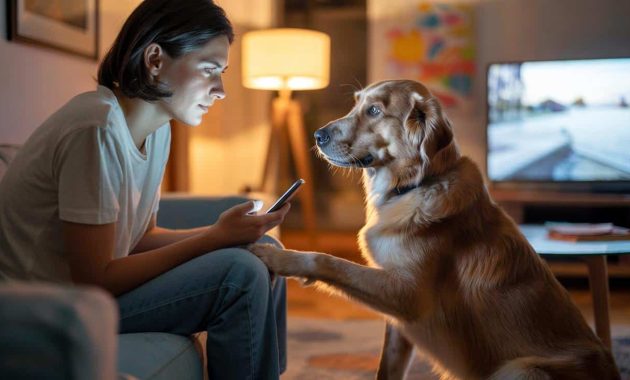
The first time it happens, you probably melt a little. You’re scrolling on your phone, half watching a series, and suddenly there’s this warm paw, gently pressing into your arm. Your dog looks at you with those eyes that seem to say a thousand things at once. You smile, you say “Hi, baby,” maybe you think they just want to play or are copying that cute “shake hands” trick from Instagram. Then it happens again. And again. Sometimes at the worst moment, like when you’re stressed or almost late. The paw insists. The gaze gets deeper. You start to wonder if there’s something else going on.
Maybe your dog is telling you more than you think.
When your dog’s paw is a message, not a game
Once you notice it, you can’t unsee it. That paw on your knee when you close the laptop. That paw on your thigh when your voice gets a bit sharp on the phone. That paw pressed into your chest when you’re lying on the couch staring at nothing.
Many animal behaviorists agree on one thing: the paw is rarely random. It’s a signal, a kind of canine shortcut. A way to “tap” you like a notification.
Picture this scene. A family in their kitchen, noisy evening, kids arguing over homework. The mother, tense, rubs her temples. Under the table, their golden retriever stretches out and gently places a paw on her leg. She looks down, distracted for a second, and he holds her gaze, calm, almost insistent.
Later, she tells an ethologist that it’s “like he’s asking if I’m okay.” The expert smiles and says many dogs do this when they sense emotional tension. Not as a miracle therapist. Just as a social animal wired to respond to the moods of their group.
From an ethological point of view, the paw is just one tool in the dog’s communication kit. They have body posture, tail movements, ears, gaze, vocalizations. The paw, used gently and repetitively, often marks a request: “look at me”, “touch me”, “respond to me”, or simply “stay with me.”
Dogs are masters at reading micro-signals in us. Their heart rate can sync with ours. They smell hormone changes. When they extend a paw, they might be trying to re-establish contact with a human who has mentally “left the room”. *It’s less about politeness, more about keeping the invisible thread intact.*
What your dog might be asking for with that paw
One of the most common reasons experts cite is a very down-to-earth one: your dog is seeking physical contact. Not necessarily wild cuddles. Just touch. Pressure. Presence.
When your dog rests a paw on you, they are often checking: “Are we still connected?” The gesture can be soft, the claws barely touching your skin, or more insistent, almost pushing. Both are variations of the same need: social proximity. Dogs are animals that survive in groups. Silence from their group is rarely neutral.
Take Luna, a mixed-breed rescued from a shelter. Her new guardian thought the pawing was “cute begging” and tried to ignore it. Each evening, the same sequence: Luna would lie down next to the couch, wait a few minutes, then creep closer and place a paw on his arm. If he didn’t react, she’d add a little pressure, then a second paw.
➡️ At 65, “electric upgrades are required in 1 out of 5 installations”
➡️ Goodbye, Christmas tree : meet the plant hitting florists that’s set to trend in
➡️ Neither swimming nor Pilates: The best activity for over 65s with joint problems
During a consult, a behaviorist noticed Luna did this most often when the owner was tense or absorbed in screens. The dog wasn’t just angling for treats. She was trying to pull him back into shared space. Once the man started pausing, breathing, and giving her two minutes of calm touch, the pawing episodes became less frantic and more peaceful.
From a learning perspective, the paw also has a history. Many of us have rewarded it without thinking. Your dog puts a paw on you, you talk to them, pet them, answer out loud. For a dog’s brain, that’s a tiny jackpot. Every response from you reinforces the habit.
At the same time, behavior specialists remind us that **a paw placed gently and repeatedly can indicate discomfort, stress, or uncertainty**. Some dogs do it during storms, arguments, or even when a new person enters the home. It’s a way to anchor themselves to their human and get more information about what’s going on. The trick is not to demonize the gesture, but to read the whole picture: ears, breathing, posture, and context.
How to respond to the paw… without sending the wrong message
The first step, say trainers, is simple: pause and observe. Before you react on autopilot, look at your dog’s body. Are they relaxed, loose, mouth slightly open? Or are they stiff, yawning repeatedly, licking their lips, pupils wide?
If your dog seems calm and just wants contact, you can answer with what experts call “social touch”: slow strokes on the chest, sides, or base of the neck. Speak softly, lower your own tension. You’re not just petting your dog. You’re telling them, “I’m here, we’re okay.”
Where things get tricky is when the paw has become a constant demand. The dog who paws at you every ten seconds during dinner, or scratches your leg until you give in. That’s where many guardians feel guilty or annoyed and then feel guilty about being annoyed. We’ve all been there, that moment when you love your dog deeply but secretly wish for five uninterrupted minutes.
Positive trainers suggest setting gentle boundaries. Offer attention before the pawing starts, through short play sessions, walks, or a calm brushing ritual. When the pawing is excessive, redirect rather than scold: stand up, lead your dog to a mat, and reward them for settling. Let’s be honest: nobody really does this every single day. But small, repeated tweaks can shift the pattern.
Some behaviorists also link the “paw language” to deeper emotional states. A veterinary ethologist I spoke to summed it up this way:
“When a dog gives you its paw outside of a training context, ask yourself three questions: what’s happening around us, what’s happening inside me, and what has this gesture earned them in the past?”
To help decode these moments, professionals often highlight three main intentions:
- Seeking contact: your dog wants touch, closeness, or reassurance.
- Seeking clarity: they’re unsure, stressed, or reacting to a change in your mood or the environment.
- Seeking reward: they’ve learned that the paw opens doors to food, games, or intense attention.
**The same gesture can mean different things depending on the day**, which is why specialists insist on context rather than rigid rules. Your best “tool” is curiosity.
Living with a dog who talks with their paws
Once you start treating that paw as a sentence instead of a trick, something shifts in the relationship. You might notice patterns you never saw before: the paw that appears every time you raise your voice, the one that comes just before a storm, or the one that quietly lands on you when you’re crying on the edge of the bed.
Many guardians say that when they began answering the paw with real presence instead of automatic petting, their dog’s behavior changed. Less agitation, more soft eye contact. Less frantic scratching, more calm leaning. In a world that constantly fragments our attention, this tiny ritual becomes a way back to each other.
| Key point | Detail | Value for the reader |
|---|---|---|
| Decode the gesture | Observe posture, context, and your own emotions when the paw appears | Helps you understand what your dog is really asking for |
| Respond with presence | Use calm touch, soft voice, and short focused moments of attention | Strengthens the bond and reduces anxious or insistent pawing |
| Set gentle limits | Redirect excessive pawing to a mat, rest, or another behavior you like | Protects your space while respecting your dog’s emotional needs |
FAQ:
- Question 1Is my dog manipulating me when they give me their paw all the time?
- Question 2What if my dog only gives me their paw when they seem stressed or scared?
- Question 3Should I ignore the paw if I don’t want to reinforce the behavior?
- Question 4Can constant pawing be a sign of a medical problem?
- Question 5How can I teach a healthier “contact ritual” with my dog?
Originally posted 2026-03-11 07:17:19.